What a joule rating on a surge protector actually tells you
Joules are a budget that gets spent, not a wall that stays up. How our surge line is rated, why the metal housing is on the spec sheet, and when a strip has quietly stopped working.
Our surge protectors are rated between 360 and 3840 joules, and that spread confuses people more than any other number we print. It is not a strength rating in the way it reads. It is closer to a fuel gauge.
A budget, spent in pieces
Inside the housing are metal oxide varistors. Above a threshold voltage they become conductive and shunt the excess to ground, and each time they do it they lose a little of their ability to do it again. The joule figure is roughly how much total energy the parts can absorb across their whole life, not how much they can take at once.
The consequence is the part people miss. A surge protector wears out silently. It keeps passing power to your equipment long after it has stopped diverting anything, because the outlets and the varistors are separate. A strip that has been on a workbench for eight years is a power strip with a light on it, and nothing more.
This is why our units carry a diagnostic LED, and why we would rather you glanced at it than trusted the age of the thing. If protection is out, the strip is finished, and no amount of joules on the box changes that.
Reading the rest of the spec sheet
- Clamping voltage. The level at which the varistors start conducting. A lower figure means they engage on smaller excursions.
- Response time. Measured in nanoseconds, and honestly not where the differences live between units in this class.
- Line filtering. Separate from surge handling. This is the part that deals with the ordinary electrical noise a shop compressor puts on the circuit.
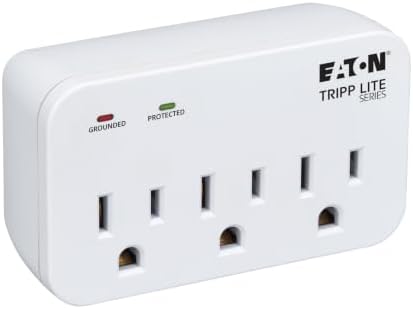
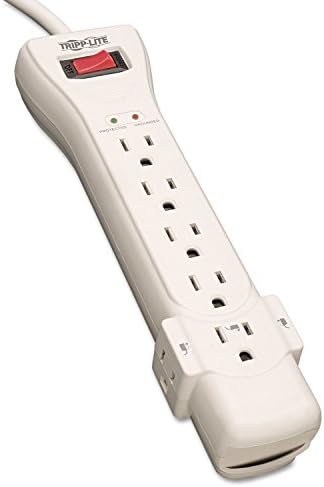
- Diagnostic LEDs. One for protection status, one for a correctly wired outlet. The second one has found more bad wiring in old buildings than anything else we make.
Why we build some of them out of metal
Our Isobar units use a heavy sheet metal housing, and it is not styling. Isolated filter banks inside need a shield between them, the metal provides it, and the same shell is what lets the unit take a tool case dropped on it at the end of the bench. Plastic strips crack at the outlet face, and a cracked outlet face is a live part you can reach.
Where a strip lives on a floor, gets stepped on, or shares a bench with hand tools, this is the version to buy. Where it is going behind a media cabinet and will never be touched again, it is not.
Outlet count, and the spacing between them
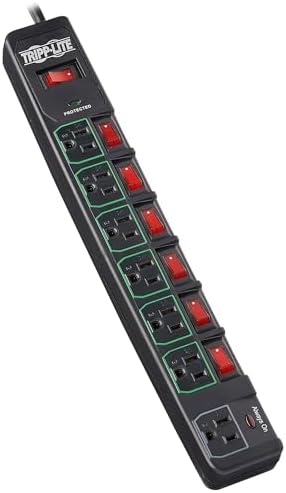
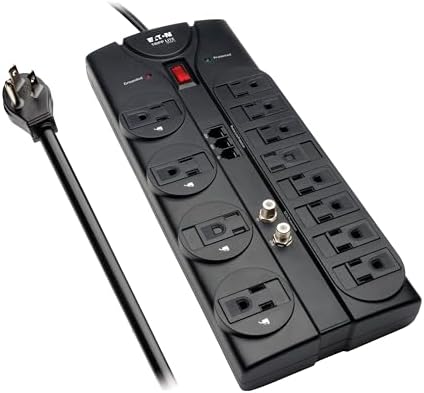
We build these from 3 outlets up to 24, and past a certain point the useful question is not how many but how far apart. Wall warts cover their neighbors. Our longer strips space some outlets wider or turn them sideways for exactly this reason, and a 12 outlet strip where four positions are blocked by transformers is an 8 outlet strip.
Count what you will actually plug in, look at how many of those plugs are bricks, and buy accordingly.
What a surge protector is not
It is not a battery backup. It does nothing at all when the power goes out, and equipment on it stops with everything else. If your concern is an unsaved file or a shutdown mid-write, that is a battery backup question and no joule rating answers it.
Nor is it a substitute for the wiring in the wall. A protector diverts to ground, and where there is no proper ground it has nowhere to divert to. The wiring fault LED on our units exists to tell you that before you rely on the thing.
Our full surge protector and power strip line lists the joule rating and the outlet count on every model.