Copper or fiber: choosing what to run between the closets
Where Cat6a stops being worth it, when a run should be glass instead, and what the OM and OS numbers on our fiber jackets mean in practice.
We make both, and we would rather you ran the cheaper one where it works. Most of a building should be copper. The question is only which parts should not be.
Copper, by category
We build Cat5e, Cat6, Cat6a and Cat8, and the gap between the first two is smaller than the marketing in this industry suggests. Cat5e carries a gigabit the full hundred meters and will keep doing it for the life of the building. Cat6 buys headroom and shorter-distance 10 gigabit. Cat6a carries 10 gigabit the whole distance, and it does so by being thicker, stiffer and harder to get around a corner.
That stiffness is a real cost, not a footnote. A bundle of Cat6a needs a wider bend radius and more room in the tray than the same count in Cat5e, and pathways get planned once. Cat8 is a short-run cable by design and belongs between equipment inside a rack, not in the walls.
Our advice, unchanged for years: run the best copper you can pull to the desks, and do not buy category above what the switches will ever speak.
Where copper stops
Copper has a hard limit around a hundred meters for Ethernet, and it has a soft limit that arrives much earlier. Copper carries current, so it carries a ground reference between the two ends. Between separate buildings, or between floors fed from different panels, that is a path you do not want, because the two ends can sit at genuinely different potentials and the cable becomes the thing that joins them.
Fiber carries light. There is no electrical connection between the ends at all, which is why the run between two buildings should be glass whether or not the distance demands it.
Reading OM and OS
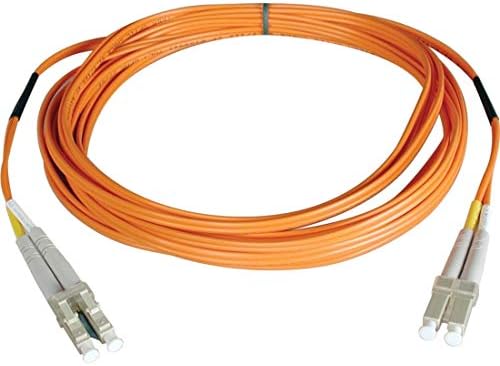
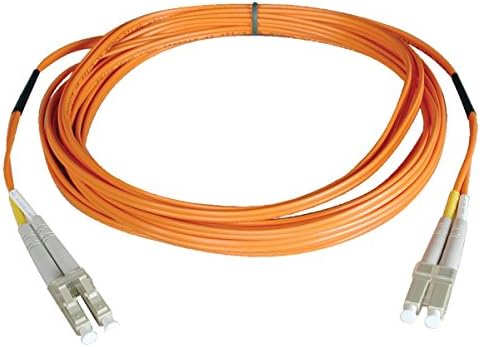
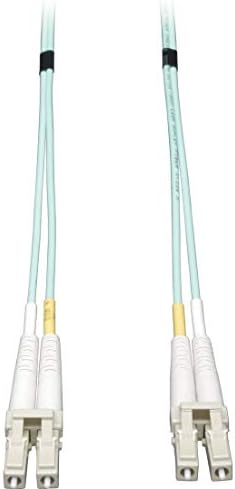
Our multimode cable is OM3 and OM4, with the familiar aqua jackets. Multimode uses a wider core and inexpensive optics, and it is the right choice inside a building. OM4 goes further than OM3 at the same speed, and past a few hundred meters that starts to matter.
Our singlemode is OS2, in yellow. The core is much narrower, the optics cost more, and the distance it will carry is measured in kilometers. Between buildings on a campus, this is the one.
The colors are not decoration. Aqua and yellow are the convention, and a closet where the jacket color tells you the fiber type is a closet where the next person does not guess.
Connectors, briefly
- LC is the small duplex connector on most current equipment, and what we terminate most of our patch cords with.
- SC is the older square push-pull type, still common on wall boxes and older gear.
- ST is the round bayonet, mostly encountered on existing infrastructure rather than chosen new.
- MTP and MPO carry twelve or more fibers in one body, for trunk runs between panels where individual cords would be unmanageable.
Buy the run, then buy the patch cords
Permanent cable and patch cable are different purchases and mixing them up is the most expensive habit in this trade. The run through the wall or ceiling is solid conductor, it gets pulled once, and it terminates on a patch panel. Patch cords are stranded, they flex, and they are consumable.
We sell bulk copper on spools from 100 feet up to 700 for exactly this: the permanent run is cut to length on site, and nothing about moving a workstation later should involve pulling new cable through a ceiling.
Our copper cable and fiber optic ranges are listed by category, length and connector.